Cameron’s financial hardship and life in a temporary home
Remarkably Bright CreaturesCameron Cassmore’s financial hardship turns travel and shelter into a running calculation: how much cash remains, what the camper will cost next, and whether his work can produce money quickly enough to meet an obligation to Jeanne. In Washington, he has a vehicle he technically owns, but little reserve, missing luggage, and no settled home. Ethan Mack’s offer of help makes one night safer without resolving the larger arithmetic.
A Journey on a Narrow Budget
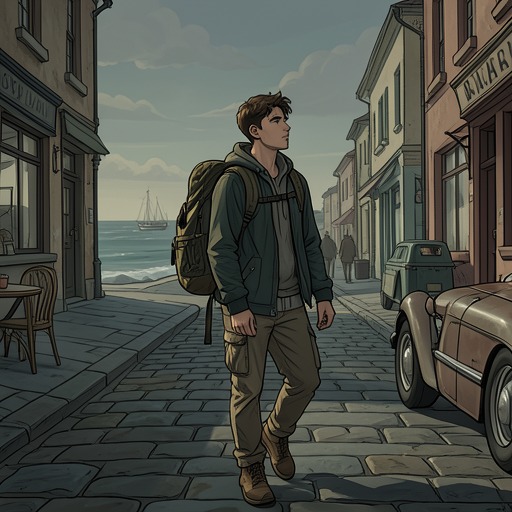
Cameron drives north toward Sowell Bay in a rough camper whose engine rattles and whose loose belt whines. Its purchase price was twelve hundred dollars, negotiated downward after the seller’s friend warned him that it drove poorly and pointed out a replacement belt still in the glove compartment. Although he has paid for the vehicle outright, the money came from Jeanne in what he understands as a loan, not a gift. Ownership brings some satisfaction, but it does not amount to financial security.
By the time Cameron is two hours north of Seattle, he has roughly eight hundred dollars left. He has spent six dollars on an overpriced latte, a small indulgence that registers against the cash he is trying to stretch. The camper removes the need to pay for lodging, so he tells himself that the balance is workable until he finds Simon Brinks or his missing duffel bag catches up with him. That confidence is provisional: his money must cover fuel and whatever the vehicle demands, while his search for Brinks has not yet produced a result.
His first night in Washington offers little rest. Cameron sleeps in a far corner of an industrial parking lot, then bolts awake before dawn when a police car arrives on the gravel. He watches it through the camper’s small window and drives away quickly. The episode makes the distinction between possessing a vehicle and having a secure place to live plain: the camper gives him somewhere to sleep, but not somewhere he can assume he is welcome to stay.
The Camper as Shelter and Liability
The camper is both Cameron’s makeshift home and the source of repeated expense. Its brown fabric seat is musty and scratchy, and the mattress in the back smells bad enough that, after several nights, Cameron drags it outside and throws it onto Ethan Mack’s driveway. He sleeps instead on the greasy plywood beneath it, an uncomfortable improvement over the stench rather than a real solution. By then, his back aches from his work, and the bad mattress offers no relief.
A flat tire and damage to the wheel area turn the vehicle’s flaws into an immediate financial crisis. Ethan calls a friend who drives for a towing company; the friend hauls the camper to Ethan’s house without charging Cameron. The tow gets it out of a grocery-store parking lot, but it does not pay for the repair. Cameron knows the damaged rim and bent wheel well may be costly, recalling that a repair to an old Jeep had once cost several hundred dollars.
The eventual bill consumes seven hundred of the eight hundred dollars he had left. With only a hundred dollars remaining, Cameron is depending on his missing luggage not to remain missing and on his first aquarium paycheck, due Friday. He counts the wait as three more days. A repair that restores the camper’s mobility therefore also strips away nearly all his financial margin: the vehicle remains his shelter, but keeping that shelter usable leaves him close to having no cash at all.
Work, Repayment, and the Arithmetic of Delay
While staying at Ethan’s house, Cameron hears about a maintenance position through Ethan’s local connections. Terry Bailey offers him twenty dollars an hour for twenty hours a week. Cameron is willing to take more hours, but the offered schedule is not enough to solve his immediate problem. After taxes and fuel for the camper, he calculates that it could be the end of summer before he repays Jeanne, even if he saves money by eating expired groceries Ethan brings home from the store.
That timeline matters because Jeanne’s cruise deposit is due sooner. Cameron’s need is therefore not simply a general wish for employment: he has a specific debt to repay, and the part-time wage makes repayment too slow for the deadline he has in mind. The prospect of earning money helps, but it also clarifies the limits of the help. A job can keep him moving toward solvency without making the numbers work in time.
The physical demands of the aquarium work compound the precariousness of his living conditions. Cameron chops buckets of mackerel bait and hauls them around the building; afterward, his lower back throbs, a knot sits beneath his shoulder blade, and his neck pops when he turns. Even routine driving aggravates the problem because the camper’s passenger-side mirror is broken and he has to turn his head frequently. Work brings an expected paycheck, but his body and vehicle both require attention that his small balance can scarcely afford.
Temporary Help and Unsettled Security
When the camper’s tire trouble delays Cameron’s plans, Ethan lets it be towed to his driveway. Cameron checks whether parking there is acceptable, and Ethan agrees on the condition that Cameron keep the morning noise down. The arrangement means Cameron will not have to search for another questionable parking lot that night. It is a concrete reprieve, though still an informal, temporary place to stay rather than a home of his own.
Over a drink at Ethan’s kitchen table, Cameron feels his shoulders ease for the first time since leaving Modesto. Ethan says he is glad to have company, and Cameron agrees. The welcome gives the episode a human counterweight to its financial calculations: after a night spent alert to a police car and hours spent arranging a tow, he is briefly able to relax. Ethan also offers the possibility of work, though he does not know Simon Brinks. His local connections may still help Cameron, but that remains a hope rather than a plan with guaranteed results.
The Shape of Cameron’s Precarity
Cameron’s circumstances repeatedly convert apparent gains into narrower forms of security. Buying the camper means he no longer needs to pay for a room, yet the camper’s poor condition brings a repair bill that consumes most of his savings. The tow is free, but the repair is not. The job supplies income, but at twenty hours a week it cannot meet Jeanne’s repayment timetable. Ethan’s driveway provides a safe place for the night, but the arrangement depends on another person’s permission.
The state is defined less by a single calamity than by the small margins between one problem and the next. Cameron tracks the eight hundred dollars, the seven hundred spent, the hundred remaining, and the three days until payday because those amounts determine what he can do. His temporary home is simultaneously transportation, shelter, and a financial liability; work is necessary but physically taxing; and assistance gives him room to recover without erasing his debt. This precarious balance shapes his early life in Sowell Bay, where each practical reprieve buys time rather than certainty.